Defence: JIMEX
skills in northern Arabian Sea

Dinakar Peri New Delhi
The 4th edition of the biennial India and Japan naval exercise is under way in the borth Arabian Sea, the Navy said. This is the first exercise following the conclusion of the mutual logistics support agreement early this month.
The maritime cooperation has significantly increased between the two sides with focus on information sharing and Maritime Domain Awareness (MDA) in the Indian Ocean Region (IOR) and Indo-Pacific.
“JIMEX-20 will showcase high degree of inter-operability and joint operational skills through conduct of a multitude of advanced exercises, across the spectrum of maritime operations,” the Navy said in a statement. Multi-faceted tactical exercises involving weapon firings, cross-deck helicopter operations and complex surface, anti-submarine and air warfare drills will consolidate coordination developed by the two navies, it said.
Stating that naval cooperation has increased in scope and complexity over the years, the Navy said advanced level of operations and exercises planned during JIMEX-20 are indicative of “the continued upswing in Indo-Japanese defence relations and continued efforts by both governments to work closely for a more secure, open and inclusive global commons, in accordance with international regulations.”
The three-day war games which began on Saturday are being conducted in a “non-contact at-sea-only format”, in view of the COVID-19 restrictions.
The Navy has deployed indigenous stealth destroyer INS Chennai, stealth frigate INS Tarkash and fleet Tanker Deepak while the Japanese Maritime Self-Defense Force (JMSDF) has deployed Kaga, an Izumo Class Helicopter Destroyer and Ikazuchi, a guided missile destroyer. The P8I long-range maritime patrol aircraft, integral helicopters and fighter aircraft will also participate, the Navy said.
The two countries have made steady progress in MDA based on the implementing arrangement for deeper cooperation signed between the two navies.
**************************************************************************************************
**************************************************************************************************
India and Japan Sign Military Logistics Agreement for All to See
Asia Defense | Security | East Asia | South Asia
The publicly available Acquisition and Cross-Servicing Agreement demystifies military logistics agreements for many in India.
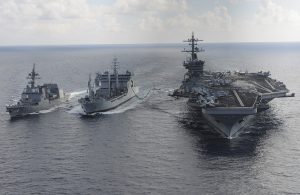
US, Japanese and Indian Forces Train Together During Exercise Malabar
Credit: Flickr/U.S. Indo-Pacific CommandOn September 9, India and Japan signed an “Acquisition and
Cross-Servicing Agreement” that would allow the militaries of the two countries
to exchange supplies and services on a reciprocal basis during exercises in
which both participate, U.N. and humanitarian assistance operations, as well as
visits to each other’s ports. Japan becomes the sixth country with which India
has such an arrangement, adding to the United States, France, Singapore, South
Korea, and Australia.
Since 2015, Japan has participated in the U.S.-India Malabar
naval exercises, which have grown considerably more sophisticated over the
years.
In a press statement, the Indian foreign ministry noted that
Prime Minister Narendra Modi and his counterpart, the outgoing Abe Shinzo,
“…concurred that the Agreement will further enhance the depth of defense
cooperation between the two countries and contribute to peace and security in
the Indo-Pacific region.” Interestingly, the Japanese foreign ministry spoke of
the agreement’s ability to enable Japanese and Indian militaries contribute to
“international peace and security,” not mentioning any theater in particular.
Agreements such as the one India just signed with Japan
systematize the procedure of mutual supply of goods and services relevant to
the two militaries’ operations, within predetermined parameters, in terms of
bookkeeping. This is different from such exchanges happening in an ad hoc
fashion, as has been the case in the past. Plainly put, these agreements, while
important, are far from being a “military pact,” (with all its connotations) as
the Nikkei Asian Review described it, except in perhaps a very literal sense.
The fact that India and Japan signed this agreement – under negotiation for
some time – amid the India-China crisis in eastern Ladakh provided an exciting
backdrop to a bland arrangement.
And we know it is bland because unlike other formal military
logistics arrangements India is part of, the text of the agreement with Japan
is publicly available through Japan’s foreign ministry website.
Writing on August 24 in these pages, I had noted that one of
the reasons why India’s “foundational” defense cooperation agreements with the
U.S. – including a logistics agreement – draw so much political attention
domestically is because “texts of these agreements – or even, official
summaries – remain classified fuel[ing] suspicion in a country deeply
protective of its sovereignty and independent foreign policy.” Indeed, absent a
publicly available draft of the 2016 U.S.-India Logistics Exchange Memorandum
of Agreement, certain analysts have confused it with a “status of forces”
agreement around basing rights and all that would entail.
But this is simply not a matter of placating a prickly domestic constituency overzealous about sovereignty issues. It is also a matter of communicating intent (or lack thereof) in precise terms to the adversary. Shrouding a routine, albeit important, arrangement in secrecy does not serve India’s (or its partner’s) interests when it comes to China. Transparency has its own strategic payoff.


Comments
Post a Comment